Would Hypochlorous Acid Inactivate Shamonda Virus? A Mechanistic Analysis

A newly documented zoonotic Orthobunyavirus raises a familiar question for biosecurity operators: does the chemistry of hypochlorous acid hold? A mechanistic review says the structural targets HOCl destroys in every enveloped RNA virus are present in Shamonda virus too — with important caveats on validation and organic load.
A New Zoonotic Threat Meets an Old Disinfectant
On October 22, 2026, French authorities confirmed the first documented human infection with Shamonda virus (SHAV) — a midge-borne Orthobunyavirus that had, until now, been considered incapable of infecting people. The patient, a severely immunocompromised man in his 60s hospitalized in Lyon, died in early October. French and WHO officials stress that no risk to the general population has been identified, but the event has sharpened attention on how to manage SHAV in environments where the virus is present.
One question that naturally follows: can hypochlorous acid (HOCl) — one of the most widely used and well-characterized disinfectants — inactivate this virus? No study has tested HOCl against SHAV directly. But the chemistry is unambiguous.
What Is Shamonda Virus?
SHAV belongs to the genus Orthobunyavirus (family Peribunyaviridae), Simbu serogroup. It is closely related to Schmallenberg virus (SBV) and Akabane virus. Key structural features:
- Enveloped — a lipid bilayer derived from the host cell membrane
- Single-stranded, negative-sense RNA genome (~11.3 kb, segmented into L, S, and M segments)
- Surface glycoproteins Gn and Gc forming tripodal spikes that mediate receptor binding
- Icosahedral nucleocapsid surrounded by the M-segment-encoded membrane protein
The virus is transmitted to cattle, sheep, goats, horses, and alpacas by Culicoides biting midges. In animals it causes fever, diarrhea, reduced milk yield, and reproductive disorders. In the French human case, neurological complications were "very likely linked" to the infection.
How HOCl Inactivates Viruses: The Chemistry
Hypochlorous acid is a small, uncharged, highly electrophilic molecule (pKa ≈ 7.5). In its protonated form at neutral pH, it is both a potent oxidant and a chlorinating agent. It attacks viral particles at three levels simultaneously:
1. Lipid Envelope Disruption
HOCl oxidizes and chlorinates phospholipid head groups and unsaturated fatty acyl chains in the viral envelope. This disrupts membrane integrity, causing leakage of the nucleocapsid and loss of the structural barrier that protects the genome. A 2025 Viruses study on airborne SARS-CoV-2 and influenza A concluded that the primary inactivation mechanism at low concentrations was "viral lipid peroxidation and the subsequent lipid envelope and protein shell disruption" — not direct RNA damage.
Because SHAV is enveloped, it is more susceptible to this mechanism than non-enveloped viruses (e.g., norovirus, poliovirus), which lack this vulnerable target.
2. Surface Glycoprotein Oxidation and Aggregation
HOCl preferentially reacts with nucleophilic amino acid side chains:
- Cysteine (–SH) — chlorination to –SCl; oxidation to disulfide — loss of disulfide bonds stabilizing spike conformation
- Methionine (–SCH₃) — oxidation to methionine sulfoxide/sulfone — steric distortion of binding interfaces
- Histidine (imidazole) — N-chlorination — altered pKa, disrupted active sites
- Tryptophan / Tyrosine — ring chlorination — loss of π-stacking, structural destabilization
- Lysine (–NH₂) — chloramine formation (–NHCl) — charge reversal, protein–protein interaction loss
A 2026 Microorganisms paper mapped HOCl-reactive residues on viral surface proteins in three dimensions and showed that oxidative modification and chlorination of these residues leads to structural destabilization and loss of receptor-binding function. For SHAV, the Gn glycoprotein (the primary attachment protein) is rich in these susceptible residues.
Critically, a 2023 Frontiers in Microbiology study demonstrated that HOCl induces irreversible protein aggregation of viral structural proteins (demonstrated with SARS-CoV-2 spike and nucleocapsid) at concentrations as low as ~0.6 ppm, with full inactivation at ~1.6 ppm. The authors concluded that "protein aggregation alone is adequate for viral inactivation" — the virion loses infectivity before its RNA is significantly damaged.
3. Genome Chlorination (Secondary Mechanism)
HOCl chlorinates nucleobases (particularly cytosine to N⁴-chlorocytosine, and guanine), causing strand breaks and rendering the negative-sense RNA genome non-replicable. This is a slower, secondary mechanism compared to envelope and protein damage, but it provides a redundant kill step.
Expected Efficacy Against SHAV
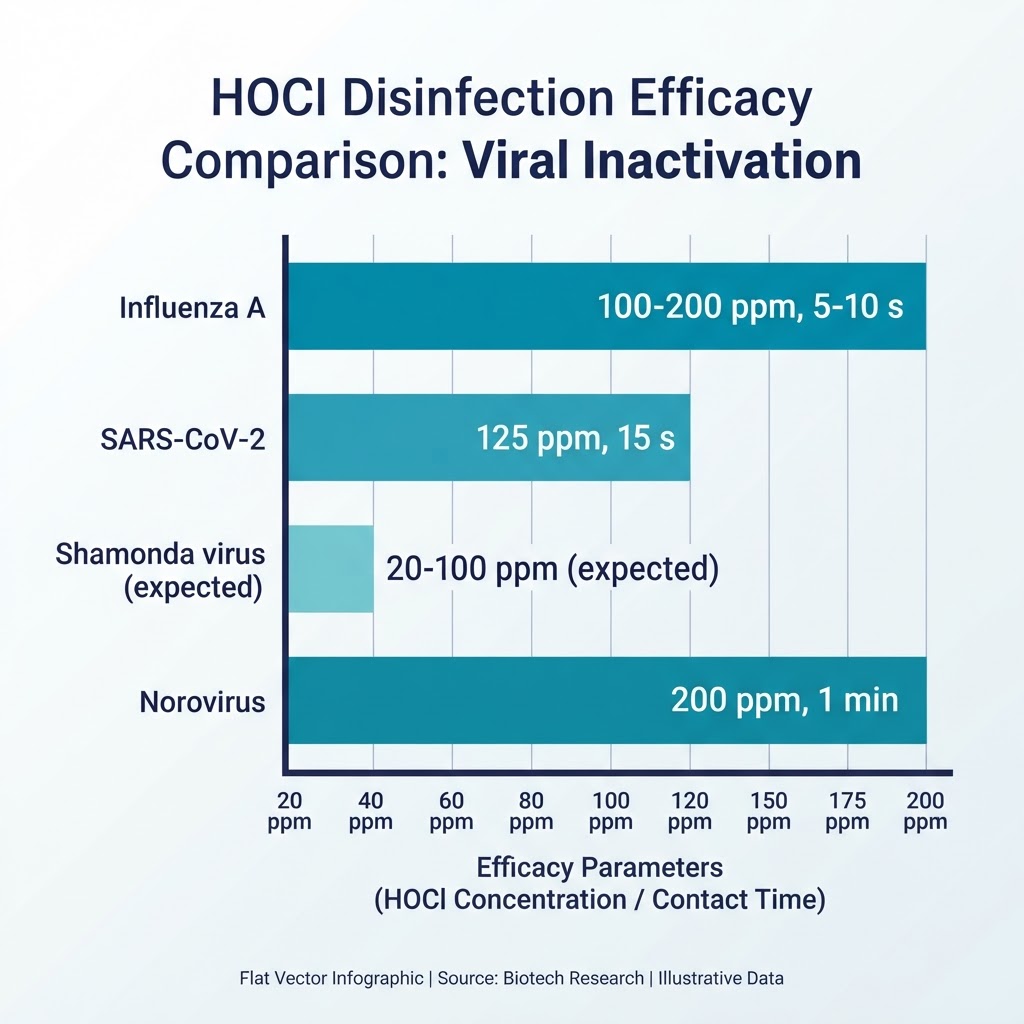
Drawing on published data for comparable enveloped RNA viruses:
- Influenza A (AIV) — 100–200 ppm, 5–10 s direct spray — ≥ 3 log reduction (PLoS ONE, 2014)
- SARS-CoV-2 — 125 ppm, 15 s — ≥ 3 log reduction (PMC, 2021)
- SARS-CoV-2 (protein aggregation) — 1.6 ppm — complete inactivation (Front. Microbiol., 2023)
- Norovirus (non-enveloped, harder to kill) — 200 ppm, 1 min — ≥ 3 log reduction (multiple sources)
SHAV, as an enveloped bunyavirus, is expected to be at least as susceptible as influenza A and SARS-CoV-2 — likely inactivated at 20–100 ppm within seconds to a few minutes under clean conditions. In the presence of organic load (blood, tissue fluid, manure), higher concentrations (200–500 ppm) or longer contact times would be prudent.
Practical Implications
- Farming and veterinary settings: HOCl sprays (100–200 ppm) are already used on dairy farm surfaces and equipment. If SHAV is present in animal environments, existing HOCl disinfection protocols would very likely reduce environmental viral load.
- Hospital and clinical settings: The French case involved a hospitalized, immunocompromised patient. HOCl-based surface disinfection (a standard in many hospitals) would be expected to inactivate any SHAV on surfaces.
- Airborne/aerosol exposure: A 2025 Scientific Reports study showed that even gaseous HOCl at low concentrations rapidly inactivated aerosolized influenza. This is relevant if there is any concern about aerosolized SHAV in clinical or laboratory settings.
Important Caveats
- This is a mechanistic prediction, not an experimental result. No CT-value (concentration × time) has been formally established for SHAV. A formal inactivation study (following EPA or ISO 14736 protocols) is needed before HOCl can be recommended for SHAV specifically.
- Organic load matters. HOCl is consumed by reaction with organic material. In environments with high organic contamination (e.g., animal manure, blood), effective free chlorine concentration drops, and higher initial concentrations or longer contact times are needed.
- pH dependence. HOCl is most effective at pH 5–6.5. At pH > 8, the equilibrium shifts to OCl⁻, which is a weaker oxidant. Formulation pH matters.
- No resistance mechanism is known. Unlike antibiotics, there is no known pathway by which a virus could develop "resistance" to a non-specific oxidant that destroys its structural components.
What's Needed Next
- A formal CT-value determination for SHAV using cell culture (e.g., Vero or BHK-21 cells) with plaque reduction assays
- Testing under realistic organic-load conditions (serum, blood, manure)
- Evaluation of HOCl stability and shelf life in the specific formulations used in European veterinary practice
- Assessment of material compatibility (HOCl is generally gentle, but prolonged exposure to certain metals and rubber should be verified)
Bottom Line
The chemistry leaves little doubt: HOCl would inactivate Shamonda virus. Every structural feature of SHAV — its lipid envelope, its surface glycoproteins, its RNA genome — is a known target of hypochlorous acid oxidation and chlorination. The virus is no more resistant than any other enveloped RNA virus for which HOCl efficacy has been demonstrated. What is missing is the formal, publishable inactivation study that would allow regulatory agencies to clear HOCl products specifically for SHAV. Until that study is done, the prediction stands on solid mechanistic ground: if you can inactivate influenza or SARS-CoV-2 with HOCl, you can inactivate SHAV.
This article is an editorial summary of publicly available information from the referenced official source. Regulations and guidance change — always consult the official source for the most current requirements.