The Line Has Crossed: Fatal H5N1 Spillover and the Biosecurity Reckoning
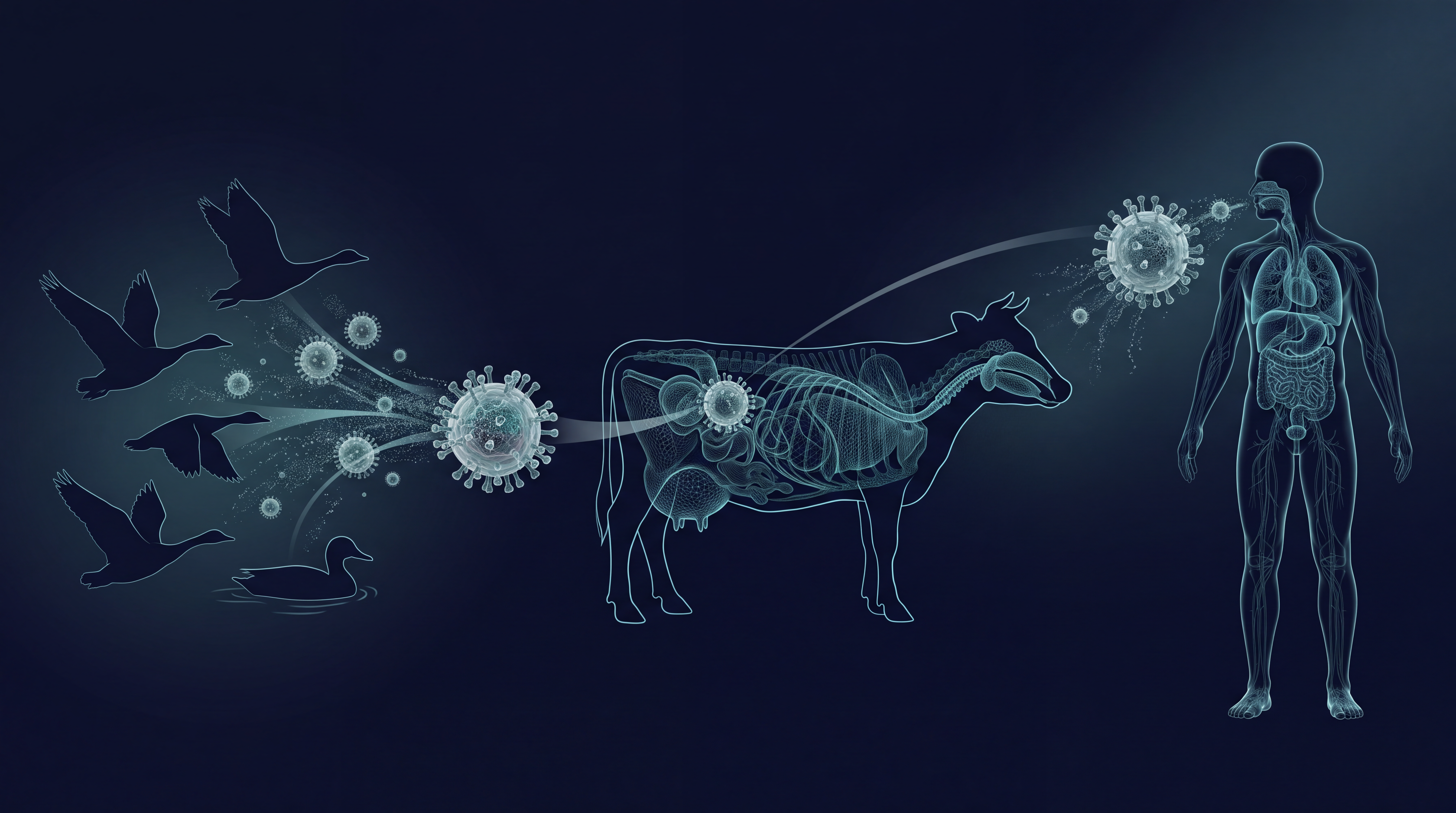
A Yakima County dairy worker has died from H5N1 — the first U.S. bird flu death in a year — with 33 herds positive in a single county, while the USDA commits $57.4 million across 147 awards in 40 states to hold the processing chain together. An executive briefing on what the crossed line means for facility biosecurity.
The warning phase is over. The boundary has fallen.
For two years the agricultural industry comforted itself with a dangerous assumption: that highly pathogenic avian influenza was an avian inconvenience — a cost absorbed through indemnity claims, partial depopulation, and the occasional chemical washdown.
That assumption broke this week.
Health officials in Yakima County, Washington confirmed that a resident has died from complications of H5N1 avian influenza after exposure to infected dairy cattle, as reported by The Associated Press. The patient, who had underlying health conditions, was hospitalized with severe illness and died on Sunday — the first U.S. death from bird flu in a year. The Centers for Disease Control and Prevention confirmed the infection as H5N1. County officials report that 33 dairy herds have recently tested positive, and that two other farmworkers were also infected but did not require hospitalization.
A worker entered a commercial dairy, was exposed to infected animals, contracted H5N1, and died. The distance between a migratory waterfowl and a hospital bed is now measured in a single milking parlor.
This is no longer a laboratory projection. The line between wild birds, commercial poultry barns, bovine herds, and human mortality has been crossed. Pathogens do not observe perimeter fences, and they do not wait for a sanitization log to be signed.
The crisis in numbers
- 1 confirmed U.S. human death from bird flu this year — Yakima County, Washington
- 33 dairy herds recently testing positive in that county alone
- 2 additional farmworkers infected without severe illness
- $57.4 million in federal processing-capacity funding across 147 awards in 40 states
- 3 concurrent pressures: HPAI, screwworm vector alerts, and pre-harvest Salmonella scrutiny

Understand the target before you treat it
An influenza A virion is a lipid envelope studded with hemagglutinin and neuraminidase glycoproteins, wrapped around eight single-stranded RNA segments. The glycoproteins are how the virus attaches and enters a host cell. The lipid envelope is what holds the whole assembly together.
That envelope is the vulnerable point, and it is the target every environmental control program is really aimed at. Disrupt the lipid bilayer and the genome has nowhere left to go. Miss it — or apply chemistry at the wrong concentration, at the wrong contact time, in the presence of organic load — and the virus remains fully intact while the treatment log reads complete.
Supply chains under siege: why the USDA just committed $57 million
At the same moment the virus claimed a life in Washington, the federal government sent another signal about the fragility of the food supply.
The USDA is moving forward with $57,424,130 in grants to expand meat and poultry processing capacity, distributed through the Meat and Poultry Processing Expansion Program (MPPEP) as 147 tentative awards across 40 states. The funding supports independent processors through equipment, facility improvements, and production expansion, as detailed by Meatingplace.
When herds and flocks are quarantined, processing lines slow or stop. When lines stop, livestock back up on farms, cash flow tightens, and producers absorb losses that no indemnity formula fully captures. Federal investment keeps plants open. It does not repopulate a depopulated layer flock, reopen a quarantined dairy parlor, or restore a buyer relationship that has already moved to another supplier. That work happens at the farm gate, in advance.
Why conventional sanitation keeps failing
Producers ask a fair question: we already disinfect — why are herds and flocks still testing positive?
- Human fatigue and manual inconsistency. A ten-hour shift does not reliably produce the same parts-per-million every cycle. Footpans fill with organic matter and neutralize disinfectant within hours. When a person is the primary barrier, the barrier has a failure rate.
- Corrosive destruction. Industrial bleach and harsh quaternary ammonium compounds attack the buildings they are meant to protect — pitting galvanized steel, degrading conduit, and eating misting nozzles. Managers then dilute chemistry to ineffective levels to preserve equipment, trading biosecurity for maintenance savings.
- Respiratory compromise in animals. Caustic chlorine chemistry sprayed inside enclosed barns irritates mucosal membranes in cattle and birds. That stress suppresses local immunity and can make animals more susceptible to secondary viral and bacterial challenges, including pre-harvest Salmonella.
- Supply chain paralysis. When an outbreak hits a county, local distributors run out of disinfectant concentrate overnight. A program that depends on trucked-in jugs is one delayed shipment away from an unmitigated breach.
The alternative: continuous, automated, on-site HOCl
The answer to a biological emergency is not a harsher poison. It is permanent mechanical infrastructure — treating biosecurity as a building utility, the way you treat electrical service or incoming water.
On-site electrochemical generation converts softened water and salt into hypochlorous acid (HOCl) continuously, on demand, at the concentration you specify:
- Automated vehicle arches and tire baths. Every milk tanker, feed truck, and service vehicle is decontaminated before its tires touch the interior perimeter.
- Continuous waterline treatment. Biofilm inside drinking lines and troughs is removed and held in check, suppressing Salmonella and viral persistence without reducing water intake or feed conversion.
- Sub-20 micron dry fog. Intake louvers and ambient air are treated without wetting litter, raising manure-belt moisture, or damaging climate controllers.
- Fast kill, low corrosion. Near-neutral HOCl performs at a 5-second contact standard, is non-toxic to livestock respiratory pathways at use concentration, and degrades to mild saline after contact — which means it can run during production instead of forcing downtime.

Protect the balance sheet before the quarantine notice arrives
Federal flock and herd indemnity programs, administered under regulations such as 7 CFR Part 53, are not guaranteed recoveries. If a regulatory review finds inadequate biosecurity records, missing contact-time documentation, or an unmanaged Line of Separation breach, a substantial portion of livestock valuation can be disqualified — at the exact moment the operation can least afford it.
Biosecurity is no longer a chore on a barn whiteboard. It is the primary control protecting your inventory, your workforce, and your ability to keep shipping.
A virus that has now killed a U.S. dairy worker, and a federal government repositioning $57 million to keep the processing chain standing, together describe the same message: the operations that automate their defense before the positive test will be the ones still in business after it.
Talk to our engineering team
Review pre-engineered integration drawings and automated on-site HOCl generation for your poultry or livestock facility.
- Contact: drcharisbiotech.com/contact
- Engineering inquiries: biosecurity@drcharisbiotech.com | info@drcharisbiotech.com
Published by the Biosecurity Engineering Team at Dr. Chari's Biotech. Outbreak details reflect reporting by The Associated Press and Yakima County health officials as of November 2, 2026; funding details reflect USDA MPPEP awards as reported by Meatingplace. Confirm current guidance with USDA APHIS and your state animal health authority.
This article is an editorial summary of publicly available information from the referenced official source. Regulations and guidance change — always consult the official source for the most current requirements.